


Three Days in Venice, Italy
Venice…one of the most popular cities in Italy. Venice…The Floating City, Queen of the Adriatic, The Most Serene. You get the picture. Venice is…Venice.

A little history to begin. (Feel free to click here to skip the history and go straight to our Venetian visit.)

In the 5th century AD, the Barbarians, mostly Germanic tribes, were invading from the north in search of warmer places to live. When I say invading, they weren’t nice, to put it mildly, to the natives of the lands they conquered. With this fact in mind, Romans from the smaller towns fled to the swamps where the Barbarians wouldn’t follow. (The locals knew where the natural canals were so most of them crossed successfully.) The swamps and marshes were their own defense system, so the newly arrived Romans didn’t need to build gigantic castles or fortifications. Instead, they dedicated themselves to adding solid land on which to build and then constructing beautiful, light buildings that wouldn’t sink. Unification of these 118 islands wasn’t as easy as it may sound since multiple languages and dialects were prevalent. (Venice itself is made up of 118 islands, but the larger lagoon area includes another 49.)
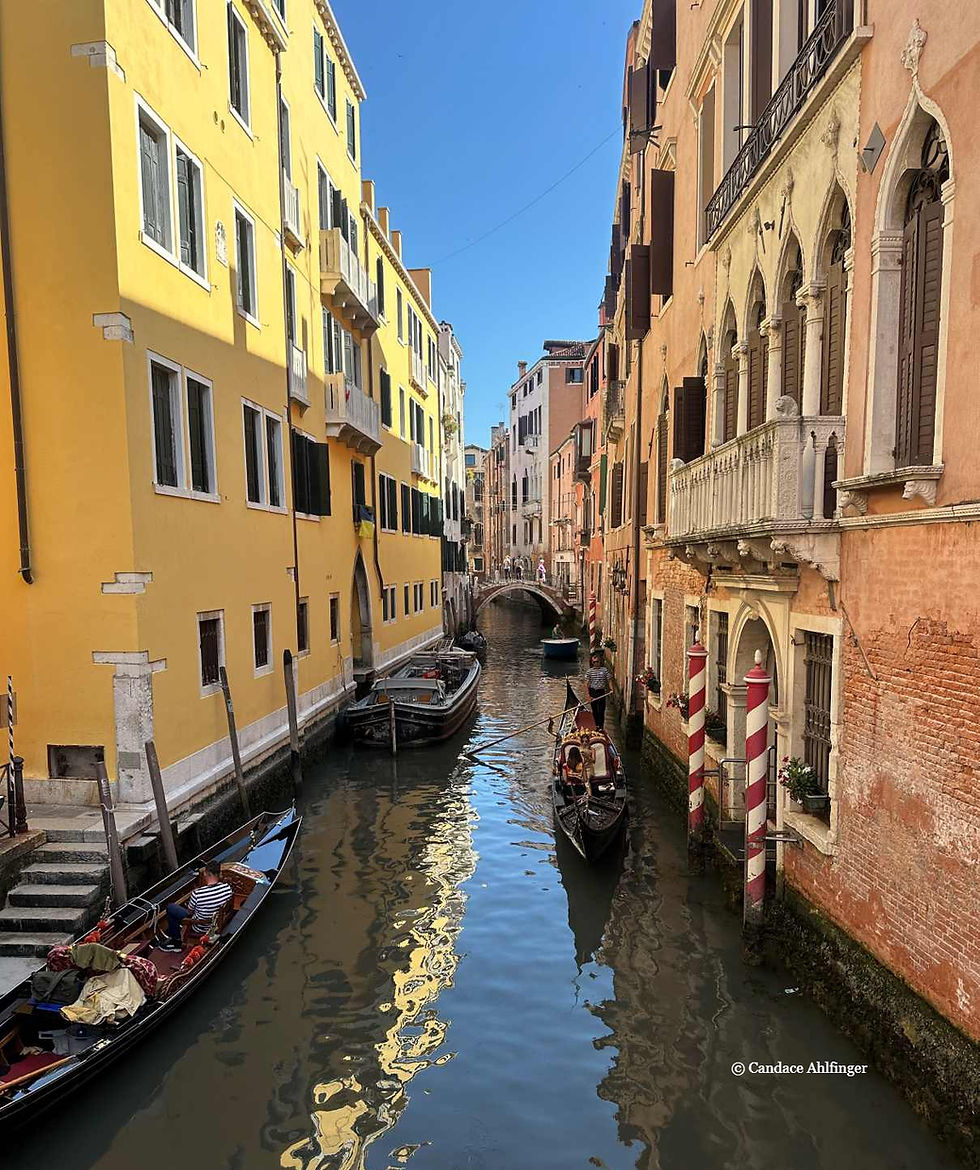
In the 8th century, the doge system was established, but it was only in the 9th century that the multiple groups became one people and began building government houses and palaces. (What’s a doge? Think “duke” in Latin. The title was not hereditary and later had no power. Many of the people elected to the office were very old so they wouldn’t keep the job long and become too powerful. The form of government was aristocratic republic. There was never a throne room because the doge was a civil servant and is always pictured kneeling to serve the people.)

And back to our trip...
Our first day in Venice we were still ensconced on our Ponant ship, which was docked within walking distance of St. Mark’s Square. We had also visited Venice twice before, so our itinerary would differ from our suggested one if it is your first visit to this remarkable city. (For one thing, if you have never been to Venice before, take a gondola ride! Yes, it is expensive and touristy, but it’s iconic Venice.)

We took a hidden garden tour with Ponant which was extremely interesting. For example, there are over 500 gardens in Venice, but only 5 of those are public. Gardens were only for the very rich because land was so expensive. Gardens also face the challenge of being flooded with salty seawater, so the roots are very shallow.

We entered the first garden through the Grand Canal—after all, canals are the streets of Venice. The Gardens of Ca' Rezzonico are a beautiful, free, glimpse into the historic gardens of Venice. The Palazzo of Ca' Rezzonico has been transformed into a museum showing the elegance of 18th century Venice as well as masterpieces by many artists such as Canaletto. Venice palaces had two floors, one for summer and the other for winter.

A few interesting items about Venetian palazzos. They were required to have cisterns to collect rainwater since drinking water was not readily available. They generally had an orchard including, of course, grapes in case they were under siege. Terrazzo floors were very uneven, but they were very practical because they are flexible, an important characteristic when the ground underneath moves continuously. In this particular palazzo, many heavier items, such as book collections, have been moved out to minimize sinking. Our next garden, privately owned, provided another glimpse into the beauty hidden behind the walls of multiple Venetian palazzos.

And then we were on our own. We transferred from the Ponant Le Bougainville to the Hotel Ai Reali and quickly struck out to explore the area. Our first stop was at the Librarian Aqua Alta, a one-of-a-kind bookstore featuring boats as shelves, boats as containers, and bathtubs with knickknacks and more books. Unfortunately, the boat and bathtub motif was a result of flooding so visitors can also see how the store has utilized their flood-soaked books as decoration and even steps with a photo op at the top. (Of course, we had to buy a few books!)

We wandered through the streets—some of which are too narrow for two adults to stand side by side—then followed GPS to San Zaccaria Church with a flooded crypt as our goal. (GPS works very well in Venice, even in the narrow, winding streets.

It is fun, however, to turn off GPS and get “lost” in the maze of streets, canals, and bridges.) San Zaccaria Church is very pretty, but the crypt and the church are under renovation and building materials blocked us from a clear view of the water-filled crypt. (If I haven’t written it lately, one of our favorite sources for unusual places to visit is Atlas Obscura.)

Our next stop, and another recommended by Atlas Obscura, was the Scala Contarini de Bovolo to see its spiral staircase and follow the steps to the top for a beautiful overview of the city. (Bovolo means “snail,” a nod to the staircase’s shell-shape construction. The building also houses an art exhibit featuring a painting by the Venetian artist, Tintoretto. After a quick lunch at Da Mamo—wish we’d been hungrier so we could have tried their luscious looking pizza and carbonara—we turned our steps to the Victor Emmanuel II statue on the shore near St. Mark’s Square (Piazza di San Marco) where we were to meet our City Wonder guide for an afternoon exploring Murano and Burano, nearby islands.

Murano, the island of glass, has been the worldwide center of glassmaking for hundreds of years. It was on this island that the technique of coloring glass originated. We traveled by boat across the lagoon which contains some salty and some river water. Just a note of history…Glassmaking was very dangerous with the threat of fire being a constant danger. Therefore, glassmaking was moved from Venice to Murano. We were able to see glassmaking in progress and go through an amazing glass company, but we didn’t have much time to explore any of the rest of the island which was disappointing. Burano, though, made up for it.

Burano was traditionally the lace-making island and opportunities to purchase beautiful handmade lace are on every street. It is amazing to take time to watch the women at painstaking work for this dying art. What captured me, though, were the colorful homes that line the canals. Legend has it that the homes were painted different colors from necessity.

The men from Burano would fish all day and then stay at the bars drinking deep into the night. In the darkness and drunkenness, they would sometimes, or often, go to the wrong house and climb into the wrong bed. Therefore, the wives had the idea to color-code their houses, so the men had no excuse to be in the wrong bed. If you visit, be prepared that most businesses close at 6:00.

All too soon, we were back on the boat heading for Venice, a city with so much to explore. We had visited the Doge’s Palace and St. Mark’s Basilica many years ago, but I needed a refresher, so we scheduled a tour through Viator to save us from standing in the long lines. (We often think that saving time is worth the extra money.) The Doge’s Palace was not a palace in the traditional sense, since Doges weren’t royalty, merely elected officials. The Palace, built in the 1300s through 1600s, was the seat of parliament, housed government offices, and was the Doge’s apartments. In fact, the prison was even located in the palace until around 1600 when a separate prison was added and linked to Doge’s Palace via the infamous Bridge of Sighs.
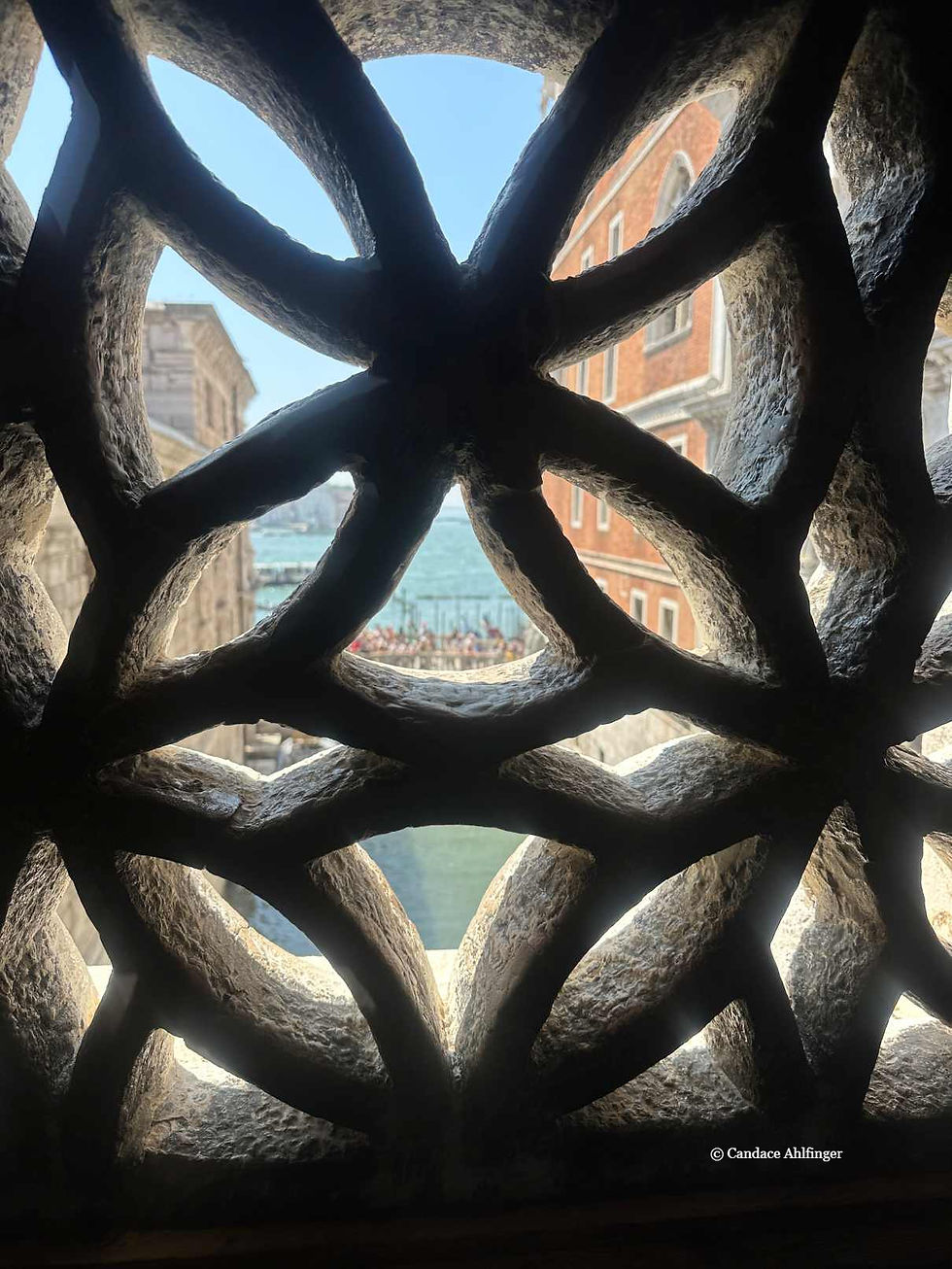
Over the life of the Republic, 120 Doges served, all of whom are eternalized with paintings scattered throughout the palace. After the fall of the Republic, the Palace served many other functions before becoming a museum.

Things not to miss in the Doge’s Palace: 1. Il Paradiso by Tintoretto, the largest oil painting in the world at approximately 72 feet by 23 feet. (It may be the second largest now.) 2. The Bridge of Sighs which, legend has it, gained its name as prisoners sighed at their last glimpse of the world before entering the prison. (The famous lover Casanova was one of the few who ever escaped the prison and it was thought that it was arranged since he was said to have been a spy for the Doge.) 3. Some of numerous pictures of Doges.

4. Mouths of Lions which were basically very secure mailboxes that allowed any citizen the ability to anonymously report someone thought to have broken a law. 5. In the largest sala, the seat of councilman, the roof was made by shipbuilders who built a hull and linked it with chains to the ceiling to suspend it.

Next up…St. Mark’s Basilica which was originally the private chapel of the Doge and his family. It gained its importance in 828 when St. Mark’s body was brought from Alexandria.

The magnificent mosaics were made in Murano. Each small piece of mosaic consists of three layers--glass, gold, then glass. (A note…entrance to St. Mark’s Basilica is free, but our tour took us past the long line.) Make certain to notice the four horses near the exterior top of the basilica. These were brought from the Hippodrome in Constantinople in 1204 and added to the façade of the basilica around 1265.

Because of deterioration, the originals were moved into the museum and copies now stand watch over the entrance.
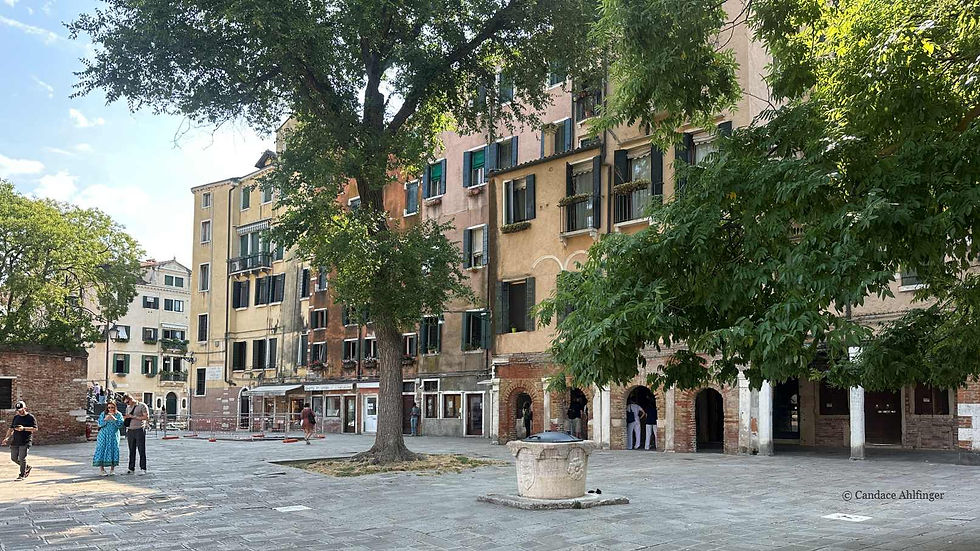
This visit, we also took a tour in the Cannaregio district of the Jewish Ghetto, the first ghetto in Europe, which was established in the 1500s. What is a “ghetto?” A ghetto was the area set aside for Jews to live in, unfortunately, a segregated society. The zone is small, but it is set apart by the presence of five synagogues and a vast history.

We also took a food tour with Devour Food Tours for a great taste of history and Venetian fare. We had such fun sampling various foods throughout the evening. I loved all the meats and cheeses, but the highlight for my husband was definitely the gelato.

We also painted masks at San Marco 596 and learned some of the stories surrounding the Carnivale in Venice. Again, the experience was fun, we learned a lot, and we came home with two masks worthy of framing. (I have to admit. We painted the base coats, but the owner added the intricate details that made them frame worthy.) We were intrigued by the integration of technology into the ancient art of mask-making. Now 3-D printing is being used to add details to the papier mache masks—very interesting.

We always allow time to sit at some of the many piazzas in the area, including St. Mark’s. Yes, it is touristy, but it’s fun to watch people and hear the musicians playing. (The hordes of people leave after the cruise ships sail.)
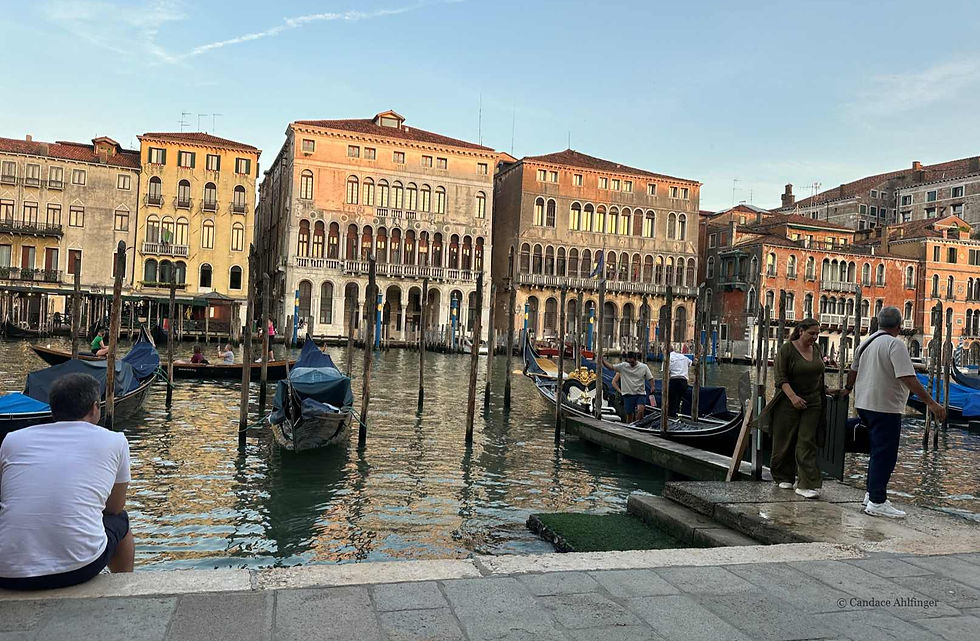
We also ate—and ate very well. In addition to the food tour and Da Mamo’s we ate at La Porta D’Acqua which was a wonderful meal and service overlooking the Grand Canal. We also dined at Alle Corone, the Michelin-recommended restaurant in our hotel, which was also fantastic. Leave it to Italy to have fantastic food.

All too soon, it was time to catch our taxi, aka boat, to the airport for our return home. As always, we weren’t able to see everything on our trip, but that gives us a reason to return.
Follow our travels by clicking here and entering your email address.
More on Malta? Click here.
For info about our day trips from Valletta, Malta, click here.


Loved your article about Venice as I was there for a Road Scholar trip Oct. 2-8 to Rome, Florence and Venice. Venice was my favorite and I would definitely like to go back. They were all crowded but if you plan right the crowds can be managed. I now have a beautiful mask from Venice to go along with one from New Orleans as well as an elegant necklace from Murano. Really enjoyed reading about your trip. The buildings were just magnificent and the food was good, too!