


Day Trips from Valletta, Malta

We were able to spend 6 days in Malta. While based in Valletta, we had many adventures that included some of our favorites--boating, history, and great food!
Gozo
From Valletta, we opted to take another City Walking Tour to Gozo instead of going on our own. We like the history and the insider tips that we gain from guides who know the area well.
We took the Fast Ferry to Gozo from the dock in Valletta. The 45-minute trip was very comfortable and a fun way to see some of the areas from the sea. When we arrived, we noticed that there were plenty of Hop On/Hop Off buses waiting for visitors, so that would be an option if you are visiting on your own. We had both a driver and guide for the day which helped in getting to places quickly and learning a great deal of information.

Our first stop was the Tempji Neolitici Tal- Ggantija in the Ġgantija Archaeological Park to see ancient Neolithic temple ruins, built between 3600 and 3200 BC making them about 1000 years older than the Egyptian pyramids. (Recent discoveries have led to the Neolithic people being on Gozo much longer ago than previously believed.) Malta and Gozo have seven megalithic temples, all of which are UNESCO World Heritage sites. The entrance to this site is through the Interpretation Centre which features a very informative movie.

Our next stop was at the Dwejra Marine Center located a few feet away from the boat that we took to the Dwejra Inland Sea. Families, snorkelers, divers, and boaters—everyone was enjoying the beautiful weather when we arrived. The original attraction in the area, the Azure Window, was destroyed in a storm, but a boat ride to the sea through an opening in the massive rocks makes the day wonderful. The clear turquoise blue of the ocean allowed us to see up to 60 feet below and feel as though we could reach out and touch the bottom. Our pilot took us to various water caves while pointing out stunning natural visions. The boat ride was over too soon for us.

Our next stop was the Cittadella, a historic fortified city in Victoria (Rabat). It has been inhabited since the Bronze Age and was later fortified by the Knights of St. John, among many others. (Make certain you walk along the high walls to get scenic views of the island and its surroundings. From one of our viewpoints, we were also able to see the Blue Lagoon, a very popular attraction on Comino Island. Based on the number of boats present, we decided to skip the crowded place.)

After wandering around the town for a while, we stopped for a quick lunch at Café Jubilee before heading to the salt flats and then back to the ferry. (We were lucky. There was no traffic on the way back to the ferry. According to our driver and guide, the line to get in the parking lot can sometimes take 45 minutes to 1 hour.)
Mdina and Rabat
(To get to Mdina from Valletta, we took Bolt. Public buses also serve the town, but we chose the quicker route so we would have more time in the cities.)

We booked a tour of Mdina and Rabat, two cities in the middle of Malta that were originally part of one city, Melita, during Roman times. Arabic influence is shown in the names of the towns, Medina is the Arabic word for “walled city” while Rabat is derived from an Arabic word for suburb. Mdina has been maintained in its original carless form with only residents being able to drive into the town. (Of course, when Mdina was founded, cars did not exist!) At one point, decreased population and then lack of cars gave the city the nickname of the Silent City.
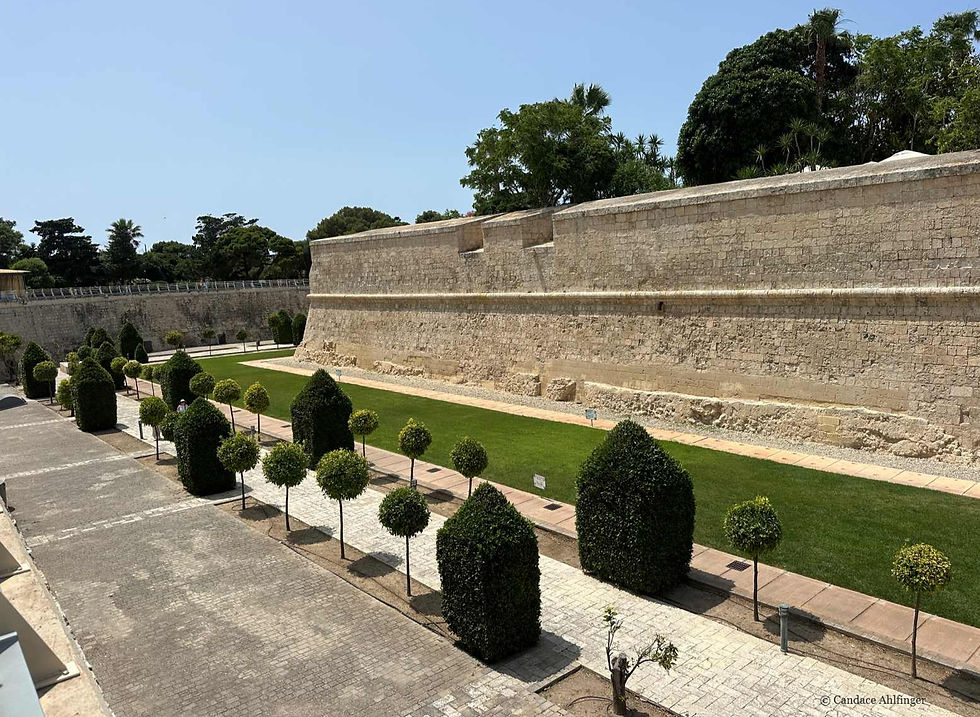
We walked over the massive bridge to get to the city gate. The dry moat around Mdina has been transformed into a peaceful garden with walks and benches for relaxation. When we stepped into Mdina through the Main Gate, we were transported back to the times of the Knights of St. John since most of the buildings were constructed or reconstructed during this period. In some places an air of neglect often signals uncertainty over ownership of buildings or the lack of money to repair them as needed. We walked by the Palazzo Vilhena, now the National Museum of Natural History, Palazzo Santa Sofia, thought to be the oldest building in Mdina, and St. Paul’s Cathedral, the original Maltese cathedral that now shares the title of co-cathedral with St. John’s Cathedral in Valletta. (We also walked by many other palazzos on the tour!) A walk on the walls of this fortified city gave us wonderful views of the island. The twisty, narrow streets are fun to explore, but Mdina is, overall, a very small town, limited in size by its gigantic walls.

We next wandered through the Howard Garden and crossed the street to enter Rabat where we discovered Ta’doni Restaurant for a tasty lunch of assorted traditional Maltese delicacies. Rabat, which is much more modern and bustling, had other surprises waiting for us. St. Paul’s Catacombs are the earliest proof of Christianity in Malta which was supposedly brought by St. Paul when he was shipwrecked on the island around 60 AD.

The catacombs, though, date back even further to the Phoenicians and Romans. St. Paul’s Grotto, where Paul was jailed during his 3-month stay, is accessible through the Wignacourt Museum. Of course, these underground areas were also used as bomb shelters during WWII.
The Three Cities
The three cities, Vittoriosa (Birgu), Senglea (Isla), and Cospicua (Bormla) lie across the bay from Valletta. (The names in parenthesis are the older names of the cities.) A large ferry runs frequently, but we opted for the more traditional dgħajsa, small ferries similar to gondolas in Venice. (You can also take a bus or use Bolt/Uber, but the boats are faster.) We enjoyed the ride and were able to get wonderful photos of Fort Angelo on our way across the bay.
Once there, we ate a leisurely lunch along the coast then walked into Vittoriosa for a visit to Malta at War Museum.

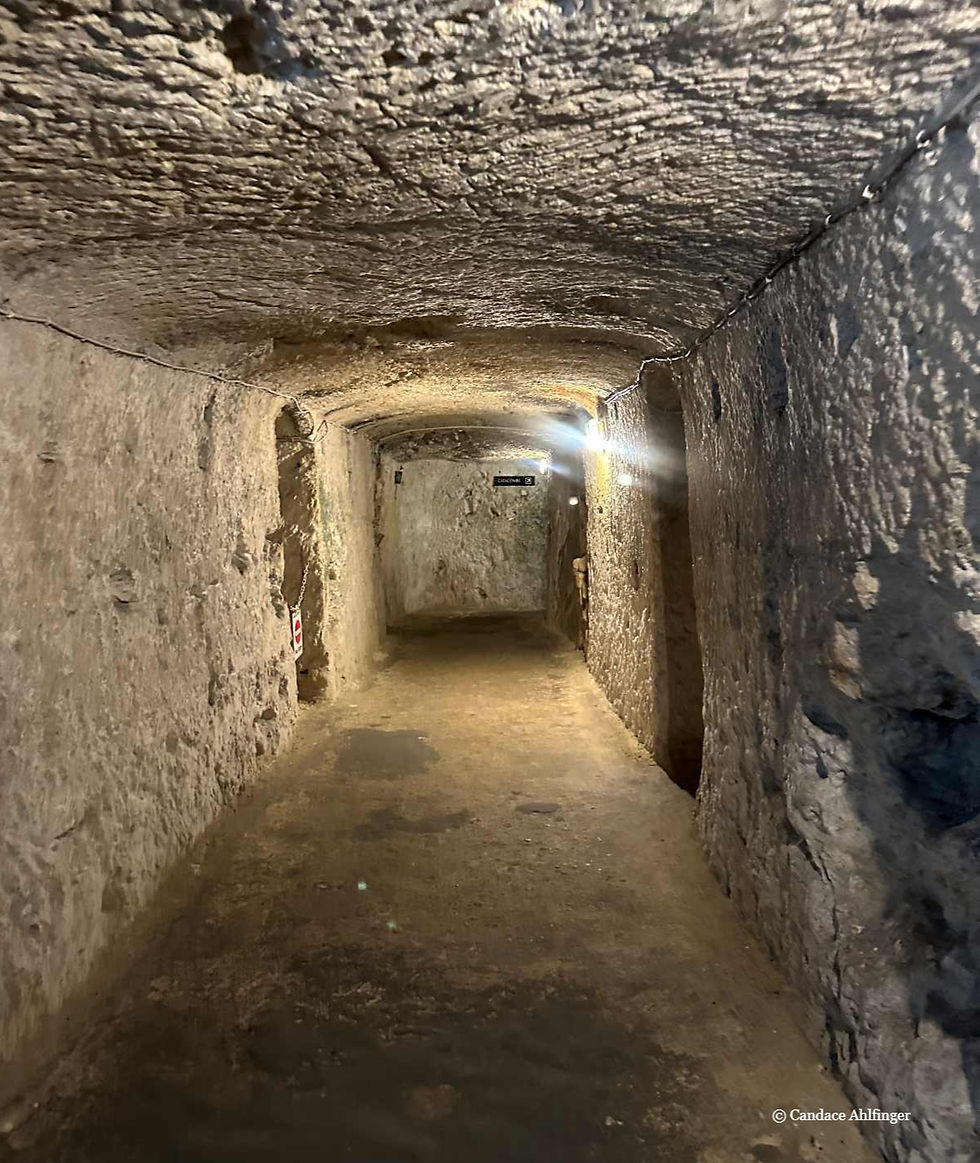
The Malta at War Museum is located in an 18th century army barrack that then served as a police station and then as an air raid precautions center during WWII. As part of the visit to the museum, we donned hard hats and ventured into the underground tunnels used as air raid shelters during the war. I can’t imagine staying in any of the numerous tunnels where the Maltese took cover during the massive bombings in Malta Blitz from 1940 to 1943, but these tunnels saved many lives.

Vittoriosa was the original seat of government for the Knights of St. John and served as the primary defense site during the Siege of Malta in 1565 by the Ottomans. Valletta replaced Vittoriosa as the Knight’s of St. John’s capital in 1570. Unfortunately, Vittoriosa was heavily damaged in WWII but many of the historical sites, including Fort Angelo and the Inquisitor’s Palace, survived.

After the Malta at War Museum, we took advantage of a shady café on a narrow-laned street and had a drink before meeting a group for a tour of the area. The walking tour gave us an overview of the area beginning with the Advanced Gate near the Malta at War Museum. The Inquisitor’s Palace, which now houses a historic home museum and the National Ethnography Museum, was our next stop. Part of the visit included the tribunal chamber, torture chamber, and prison complex used during the 224-year Inquisition period. As we wandered the narrow streets of Vittoriosa, we saw more of the colorful balconies that we had seen throughout Valletta and Mdina. We visited a home which was built in 1555 as part of the Auberge de France.

Back across the Grand Harbor via dgħajsa, through Victoria Gate, up the massive Barrakka Lift, and back to our hotel, and then dinner.

Hagar Qim and Mnajdra Archaeological Park, Blue Grotto, and the Mosta Dome
First, a disclaimer of do what we say not what we did. Mosta Dome is much closer to Mdina and Rabat, but we had a driver for the day, so we mixed and matched to see sites that were still on our list. Our hotel, the Domus Zamittello, had arranged the driver who met us at the hotel and walked us to the car. (The pedestrian-only Old Town is amazing unless you have mobility issues.)

Our first pause was a great overlook of the Blue Grotto, a turquoise stretch of water with limestone cliffs providing caves through which the water flows—beautiful! Our first official stop was at Hagar Qim and Mnajdra Archaeological Park, two of the six temples in Malta. Hagar Qim was built on the top of a ridge overlooking the sparkling blue water, while Mnajdra is located further down the hill about 1,500 feet away. Both are covered with gigantic tarps to slow erosion. The temples, more than 5000 years old, both have astronomical alignment at different times of the year.

The Blue Grotto, from the water’s point of view, was our next stop. Our goal was a boat at the bottom of a rather steep road. Multiple boats were waiting for visitors, and we quickly paid and were whisked off to the Blue Grotto. The turquoise blue waters, like those in Gozo, were absolutely stunning with the stone archways of the various caves we entered giving innumerable photo worthy shots. (We did learn that the waters appear even bluer early in the morning, but I was glad we had visited the temples before temperatures rose higher.)

Our original plan had been to go to the picturesque fishing village of Marsaxlokk next, but we had seen several fishing villages by this time, our last day in Malta, and were ready to see the Mosta Dome and call it a day. (We did drive through the Buskett Woodlands, the only forested area in Malta. The vegetation made us feel as though we had stepped into another country.)

The Sanctuary Basilica of the Assumption of Our Lady, commonly known as the Mosta Dome, was built from the 1830s to the 1860s on the location of a previous church. The Pantheon was the basis of Mosta’s design which is the third-largest unsupported dome in the world. (The Pantheon in Rome and the Rhode Island State House are the largest two.) Mosta Dome is also Malta’s largest church. On April 9, 1942, a German bomb fell through the dome during mass. Thankfully, the bomb failed to explode, and miraculously, no one was hurt. You can still see where the bomb pierced the roof.

After our visit to the church, we wandered through the town for a while especially admiring their colorful balconies for which Malta is known.

Next stop was our Valletta hotel, the Domus Zamittello, a nice dinner, and then to bed to prepare for our ocean cruise aboard the Ponant ship Le Bougainville.
Follow our travels by clicking here and entering your email address.
More on Malta? Click here.

Comments