


Ephesus Ruins, Izmir Aegean Promenade, and Cappadocia Hot Air Balloons--with Other Fantastic Turkish Sites Thrown in

Leaving Istanbul through their quiet airport—there are no announcements made over a speaker system—we flew southwest to Izmir, the third largest city in Turkey. In its history, the city was known as Smyrna and was the birthplace of Homer. Izmir is an industrial city with a busy harbor and a wonderful promenade along the water. We stayed at the Movenpick which is a block away from the Aegean promenade. The city was destroyed by the Greeks when they were forced to return to Greece, so it is a relatively new city. (Greece and Turkey were part of the same empire for over 500 years. In the 1920s, Greeks in Turkey and Turks in Greece were forced to return to their “native” land, even though many of the families had been there for much of the 500 years.)

We enjoyed walking around and had great seafood at Alliance Restaurant (with great sea bass) and Topçu Restaurant, but the primary reason we stayed the night in Izmir was its close proximity to Ephesus (Efes). We had been to Ephesus before, but it had grown substantially. No, they did not build new ruins, but they had excavated more and still have excavated only a small portion of the buildings that were originally part of the famous city.

A few notes about the history of Ephesus: According to legend, Amazons were the founders of the city, then came the Anatolian people, and then the Greeks under the leadership of Androclus in the 11th century BC. In the 7th century BC, the Lydians conquered Ephesus. Of course, more civilizations wanted control of this important harbor that was an international trade center, so the Persians then Alexander the Great arrived followed by the Romans. It was under Roman rule that Ephesus reached its peak. Estimates give a population greater than 250,000 residents.

Marble roads run throughout the massive ruins. The theatre still boasts the astounding acoustics that allowed 25,000 thousand viewers to hear what was happening down below. (Paul preached in this theatre which always led to riots.) The façade of the Library of Celsus still stands as a testament to the importance of education to the Romans. Of course, there is an underground tunnel from the library to the nearby brothel, so I guess that the importance of the brothel is also demonstrated.

The terrace houses, the massive homes of the rich, line the path. Ruins of two agoras (shopping centers), public toilets with seating for many, the temple to Artemis, and multiple bath houses can be seen. As the harbor filled with silt and plants began growing, the area became swampy which brought mosquitos and, with them, malaria. Eventually, this once glorious city was considered cursed and then abandoned.

We had the privilege of visiting the Ephesus Museum and had a private tour by archaeologist Cengiz İçten who made many of the outstanding discoveries at Ephesus.

Next up was a great lunch in Selcuk before visiting Sirince, a beautiful hilltop town with artisan markets. There we learned how to make Turkish coffee using a traditional sand stove and then had our coffee grounds read. (Our wishes are supposed to come true!)

We headed next to Dalyan with several stops along the way. The first was an evil eye bead making workshop where the beads, in every shape and size, are handmade.

Next, we stopped at Pamukkale, affectionately known as the “Cotton Castle” made over thousands of years by calcium carbonate mixing with thermal waters. These pools are self-terracing white pools that begin at the top of the mountain and descend to the bottom. Visitors are allowed to enter marked pools, barefoot of course. Legend has it that Mark Antony gave the springs to Cleopatra, but no evidence has been found to support this information. (It still makes a good story.)

At this site are also the ruins of Hierapolis, founded about 1200 BC by the Phrygians--think King Midas. After them came the Greeks and then, no surprise, the Romans that continued to expand around the thermal waters with their travertine pools. The ruins, including two theatres, baths, a large arch, and temple ruins still stand. The views are outstanding.

And then we were back on our journey to Dalyan, a beautiful city that overlooks the Dalyan River. The city does not allow large hotel chains, so all accommodations are small, with this one being family run. Across from our hotel were rock-cut tombs of the Lycians. These tombs, built in the 4th century BC, are ornate on the inside but minimalistic on the inside. (Entrance is not allowed.) Christians in this area burned themselves alive rather than be captured by Romans. (Just a note for Christmas lovers: St. Nicholas was born in nearby Myra.)

Wondering around the town was a fun adventure. Bars, cafes and souvenir shops lined the streets giving us many options to choose from. It reminds me of a beach town with the many displays and alternatives.

The next morning, we boarded a river boat that took us to the ruins of the ancient city of Kaunos. Kaunos was the capital of the Lycian league that was formed to protect the area. As with most ancient cities in Turkey, multiple civilizations were here before. The library, built under Alexander the Great, was so large that scholars started moving to Kaunos to study. Supposedly, Cleopatra was so jealous that the Kaunos library might overshadow the one in Alexandria that she had Marc Antony burn it. There are still about 965 left to be excavated and more of the story to be discovered. (A note: Turkey has more Greek ruins than Greece.)

We boarded our boat again to sail closer to the Mediterranean Sea. As in Ephesus, the natural harbor that Kaunos once enjoyed had “moved” away from the city because of silt. After returning to Dalyan, we made a trip to DEKAMAR, a loggerhead sea turtle research, rescue, and rehabilitation center. It was amazing to see the work they do and the positive difference they make in the lives of the sea creature. We walked down to the beach, but it was too cold for us to swim. The view was great, though. After another night in Dalyan and a great meal at Yakamoz Restaurant, we headed for Konya for a moving visit to the Mevlana Museum, the burial place of Rumi and the center of the Whirling Dervishes.
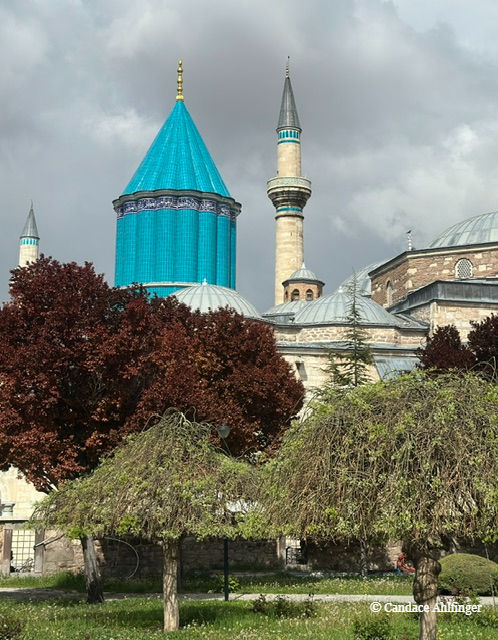
Konya, known as Iconium when Paul preached there, is one of the oldest cities in Turkey. It was the capital of the Seljuks, a nomadic Turkish empire that preceded the Ottoman Empire. The city has changed from pagan, to Christian, and now to Sufi Muslim. Because of Rumi’s influence, the area had become a cultural center before he died in the early 13th century. His philosophy believes that it doesn’t matter who you worship if you are good of heart and compassionate. (Great idea!)
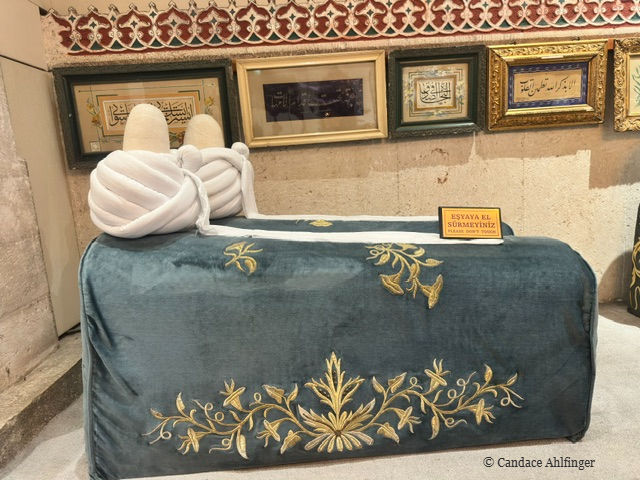
The tombs within the Mevlana Museum represent the fact that no matter what your importance or wealth, you end up in a shroud. I have been so intrigued by his teachings, which still have a large following today, that I have been reading his poetry.

The practice of whirling dervishes existed before Rumi, but he formalized the practice into a religious ritual that is still used today. We were fortunate to return to attend their religious ceremony in Cappadocia later which meant even more since our guide, Şenol, had given us the background and meaning of the ritual. (We were not able to take pictures during the actual ceremony, but they graciously provided a photo op later.)

Our last stop before arriving in Cappadocia was at the Sultanhani Caravanserai. So, what is a Caravanserai? It was a place, built along the Silk Road, to provide for merchants and their families to stay as they traveled. The Turkish sultans constructed them every 20 km—approximately 1 day’s ride by camel--to attract the travelers since commerce was extremely important. Caravanserai were free to stay in and had large walls to keep out marauding bandits. The temple in the middle was used by multiple religions because the traders came from many different places and practiced diverse religions. (Even the camels stayed inside. The porosity of the volcanic building rocks maintains the camel smell even today…or maybe it was just the power of persuasion?!?) If you’ve been wondering, the word “Caravanserai” came from the Persian word, “Karvan” which is a group of desert travelers or traders traveling together.
And then, to our next stop…Cappadocia!
Cappadocia—perhaps the reason we took this tour! I couldn’t wait to see and ride in a hot air balloon over the fairy chimneys. Little did I know that the Cappadocia area itself was magical and has a long history. We stayed in Göreme/Nevşehir at the Zemi Hotel Cappadocia which is in easy walking distance to the main town.

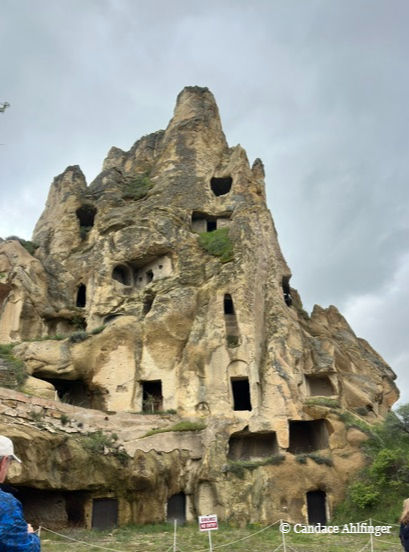
After settling into our hotel, one of our first stops was to the Göreme Open Air Museum which gave us the opportunity to visit many churches that had been carved out of rock in which Christians hid from ravaging bands of Romans. Let me back up…

Cappadocia was on the Silk Road so it was always a center of trade. The Hittites, in about 1800 BC, discovered that the soft volcanic rock, tuff, could be dug out and made into homes and hiding places from the Phrygians. The Phrygians overtook the Hittites and further excavated and built more houses. Christians had been in the Cappadocia area as early as the 1st century AD with more coming in the 4th century. However, from the 8th to 11th centuries, there was a great expansion of the numbers of Christians because of intense persecution by the Romans. To escape captivity and/or death, the Christians took refuge in the cliffs and fairy chimneys where they dug tunnels and rooms into the soft volcanic tuff.

Now, many of the caves are easy to find because of erosion. In the Göreme Open Air Museum, a UNESCO site, there are 11 examples of early Christian churches and monasteries for visitors to walk through and admire the many frescoes that still exist. St. Theodore and St. George are both pictured in every church because they were from the area. St. Barbara Church was built for the daughter of a Roman general who fought against Christianity. He was so committed to this cause that he locked his daughter, when she converted to Christianity, in a room where she was imprisoned until she died.

Another must-see thing to do is a visit to Ozkonak Underground City which was discovered in 1972 by the imam of the town. (We got to meet him!) Ozkonak is one of 22 underground cities that have been found, but they believe there are more. The Christians never knew how long they would be underground, so they had to build storage spaces and spaces for their animals. Some of these hidden houses—the entrances at that time were generally small cave-live openings—contain 20 or more floors complete with traps to stop the Romans. Over hundreds of years, the Christians hid in these homes when persecutors came whether it was Arabs or Romans.

After our visit to the amazing museum, we were taken to a family’s home where we enjoyed a wonderful, home-cooked meal. The family was gracious to share their lives with us. Afterwards, we were able to walk into town and enjoy the many souvenir shops and a lovely coffee shop that became our go-to spot. It’s called Discount Coffee—I’m not sure why.
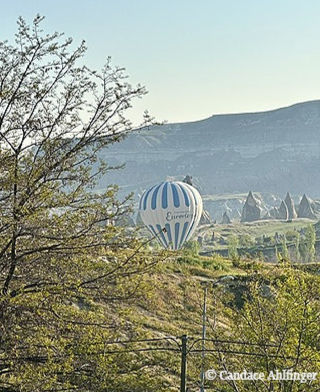
It rained much of our first day in Cappadocia so no balloon ride. The second day started off the same, but the powers that be—the government makes the decision—decided to try it so the van picked us up at our hotel at 4:45 a.m. The driver took us into the country, at least I thought it was the country, but it was hard to tell since it was totally black outside. As we left the highway, we started seeing the lights of other vans and, finally, we caught sight of balloon baskets, but still no balloons. We had to wait in the van “until weather conditions allow us to take off.” I understand that we could easily get separated from our group if we disembarked, but keeping the doors locked and the heat on for about an hour was a lot claustrophobic!) (Thank goodness for Google Translate!) and then…the balloon was cancelled. While I’m glad safety was first, I’m still disappointed that we didn’t get to go up. Our van driver rushed out of his parking spot which was lucky because we passed hundreds of vans, buses, cars, and old convertibles—all of whom were headed back into town. (Our final morning was beautiful, but we didn’t have time to fly; however, we were still able to see the magnificent balloons that fill the sky over Cappadocia and make it a magic place.

A few not-to-be-missed moments in and around Cappadocia:
The overlook points that let you see Pigeon Valley and Love Valley, which is so named because of its phallic-like fairy chimneys.

Carpet Salon Carpet making in the area. The artisans are true artists. In fact, some carpets were hung as artworks and were so excellent that we didn’t realize they were carpets.
Pottery makers who craft pieces that range from the common to works of art.

The whirling dervish ritual (discussed earlier) that was held in their cultural center in a Caravanserai.
All too soon, our time in this incredible place was over. We flew back to Istanbul, had an extra day there that I’ve talked about in that article, and then on to home.
Another adventure and so much information to process! Where will our next adventure lead us?!?

To see our visit to Istanbul, click here.
If you want a good laugh, follow my adventure in the Turkish Bath! Turkish Bath, click here.
I'd love for you to follow our new adventures--wherever they take us! Just click here and put it your email address.


Comments