


Amazing Discoveries in Istanbul, Turkey
- Candace Ahlfinger
- 33 minutes ago
- 10 min read

Let’s talk Turkey! No, not the kind that fall, not so willingly, under the axe at Thanksgiving in the United States, but the Türkey that contains ancient civilizations, modern cosmopolitan areas, and an attitude of acceptance of all religions
We were fortunate to have visited Türkiye, the preferred method of spelling the country’s name, many years ago. Unfortunately, our previous visit to Istanbul and Ephesus was short because we were on a cruise. This trip, a land trip with Collette Tours and our excellent tour director/guide, Şenol Ogru, promised to show us the country in more depth, including the hot air balloons over the ancient city of Cappadocia with its magical fairy chimneys.
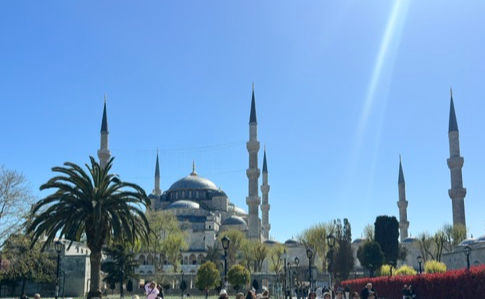
Our first stop was Istanbul, the largest city in the country. We had two days before our tour started, which is always great because we have some time to recover from jet lag and explore on our own. (This trip we arranged tours before arrival via Viator.)
Istanbul, once known as Constantinople, is a thriving metropolis with approximately 16 million people of all shapes, sizes, cultural backgrounds, and religions. It has served as the capital of three different empires, Byzantine, Eastern Roman, and Ottoman. Because of its location, Istanbul has always been very cosmopolitan. It lies on the Golden Horn, so called because of its shape and color at sunset, which is part of the Sea of Marmara. Also, the Bosphorous River was the bridge between Asia and Europe, so trade has always played an important role in its vibrancy.

Dolmabahçe Palace
Our first full day on our own, we visited Dolmabahçe Palace. (We knew we were visiting the three major sites with Collette, so we started with places and things that weren’t on the scheduled tour.)
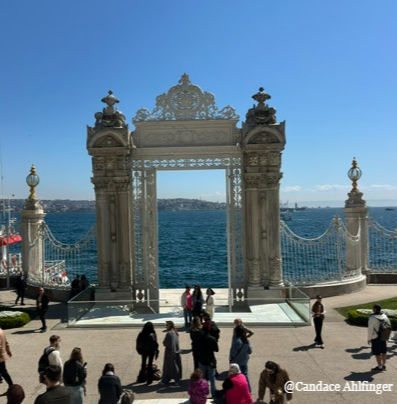
Dolmabahçe Palace, with its magnificent Clock Tower and beautiful gardens, was built from 1843 to 1856 as a more-modern European-style palace overlooking the Bosphorous River. (While we were there, the gates opening to the river had a constant line. We thought it was to catch a boat, but it was only for those Instagrammable pics.) Views from the river are magnificent since that was the way in which most people arrived at the palace. Unfortunately, the palace was extremely costly so the decorations on the land-facing side were never completed. In fact, people of the country were starving while Sultan Abdülmecid I built his new European-style palace that befitted his station in life.

The many displays of crystal opulence inside the palace are awe-inspiring. From the many huge free-standing crystal lights to the crystal newel posts on the gorgeous stairway to the second largest crystal chandelier in the world, the building overwhelms with both Baccarat and Bohemian crystal in almost every form and fashion. (Since 2025, the title of largest chandelier now goes to Saudi Arabia, but the chandelier in the Dolmabahçe is still the largest Bohemian crystal chandelier. The chandelier, which was a gift from Queen Victoria, weighs 4.5 tons!) We did take a much-needed break from wandering the palace grounds at their cute café, Limonluk, for Turkish coffee and baklava.

Later that evening we took a food tour with Bahri of Yummy Tours. We met near Taksim Square for our walking tour of both Taksim and Karakoy neighborhoods. Following our informative guide, we sampled so many dishes including but not limited to: Kokorec (lamb intestine), midye (mussels stuffed with rice and luscious seasonings), fried anchovies, fish sandwiches, tantuni (stir-fried beef in durum bread), and baklava. I’d love to be able to say which was my favorite, but each one seemed better than the last! Bahri not only led us through sampling so many excellent foods, but he also demonstrated the funicular and gave us some history along the way. He provided us a list of good restaurants to try while we were in Istanbul! (A note: All public transportation can be used with a purchased card or your credit card, but the passes give a much better deal if you are planning to use public transportation much. Turkey is extremely hilly, so public transportation is a great option!)

Basilica Cistern
The next day we were able to see the Basilica Cistern—the place I was most looking forward to visiting! We booked a skip-the-line guided tour and were very pleased, especially when we saw the long and winding queue. We met our guide in Sultanahmet Square. Augustus was great at getting us in quickly and providing info about the cistern. (A note: Looking lost or simply wandering around Sultanahmet Square will get you accosted by multiple people wanting to help you find your way—directly to their carpet store!) Augustus gave us a 20-minute intro for the cistern and then we were able to wander on our own.

Some of the interesting facts he shared: 1.) The cistern was built by Byzantine Emperor Justinian in 532 AD to supply clean drinking water to the royal palace and other administration buildings. 2.) The 336 marble columns were recycled from pagan temples throughout the area. 3.) Over 7,000 workers, many of whom were slaves, built the cistern. One column decorated with tears is said to represent all the workers—slaves and free men—killed during the construction of the cistern 4.) The cistern fell into disuse after the fall to the Ottomans because Islamic traditions required drinking water be from running water sources such as irrigation systems or streams.

Istanbul Archaeological Museum
After hundreds of pictures later, we headed for the Istanbul Archaeology Museum for an excellent glimpse into the diverse past of Turkiye including Greek, Roman, and Ottoman roots. (Throughout the city reminders of the various civilizations remain. One such is the massive Valens Roman Aqueduct under which a busy six-lane highway runs—Ataturk Boulevard.)

One amazing fact for us was the number of artifacts literally just lying around outside the building, even on the way to the restrooms, simply because they have so many! What a difference for us from the U.S. where anything older than 200 years is ancient.

After the museum, we grabbed a roasted ear of corn from a wagon—all over the city carts sell freshly roasted corn and chestnuts—and found a seat in the Gülhane Park to eat and admire the massive number of beautiful tulips.
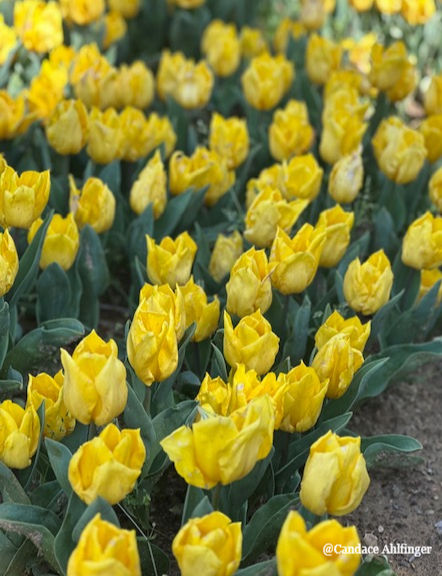
(This would have been a perfect time to also visit Hagia Sofia and the Blue Mosque because they are in the same area, but we knew we would be visiting these fantastic monuments with our tour, so we could relax and enjoy walking around the city.)

Shopping
And speaking of walking around the city…if you love shopping, Isklil Street is a must visit. During the evenings, it is wall-to-wall people and vendors, but it is a melting pot of so many groups both young and old. Our food tour showed us the passages that are hidden in plain sight as shoots off the main street.

In addition, the small side streets hide excellent small restaurants that showcase excellent Turkish and Georgian (the country, not the state) food. We stumbled upon Ficcin Restaurant and had a great meal there. After dinner, decorative lights illuminated Isklil Street to give us a fun evening stroll back to our hotel.

Chora Church
Another day, another adventure! Chora Church, Kariye Mosque, was initially built in the 4th century, was rebuilt multiple times, and had its final church transformation in the 14th century when its beautiful mosaics and frescos were installed. When the Ottomans took over, they converted the church into a mosque, whitewashed the mosaics, removed the belfry and added a minaret.

Many of the mosaics and frescos have been uncovered and are now in view. The building still serves as a mosque, so everyone must always cover both shoulders and knees and women must also cover their heads. In addition, everyone must take off their shoes to enter a mosque.

Fener/Balat
After our visit to the Chora Church, we walked through the Fener-Balat area of Istanbul. We later revisited this colorful area on a walking tour which I’m throwing in here. When built, the Fener area was home of the wealthy Greek Orthodox and Balat was the home of the Jewish community. It was impossible for me to tell when we were in one city or the other, but the colorful cobblestone streets were perfect for exploring. (We did this great ½ day tour through Viator with Fenerwalks.)

The two communities lived peacefully for over 500 years, but things changed with various incidents. During our walk, we visited the Bulgarian Church of St. Stephen, known as the Iron Church because it was constructed using prefabricated cast iron pieces. Unfortunately, the weight of the building has caused sinking issues that require constant maintenance.
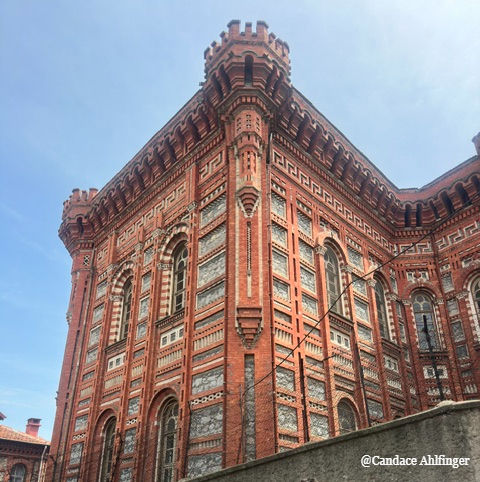
We also visited the Greek Orthodox Cathedral of St. George and viewed the Phanar Greek Orthodox College (aka Red School), a Greek high school facing serious issues now because of dwindling enrollment. Students must be born in Turkey and be Greek to attend. The student population is currently under 30 students. We also saw the outside of a local synagogue. Unfortunately, synagogues in the city were closed due to fears of terrorism. Of course, the highlight in the area for many is the colorful homes which do provide many picture-worthy opportunities.
Topkapi Palace
And now…the three top tourist sites in Istanbul. We had been fortunate to visit them many years ago, but their grandeur is still astounding. We had joined our Collette tour guide, Şenol, so we learned even more about the sites.

The amazing Topkapi Palace was our first stop. It was built between 1460 and 1478 by Sultan Mehmed II after he conquered Constantinople. It was renovated and additions made over the many years that it served as the royal residence of the sultans until 1853 when Dolmabahçe Palace was built. (Remember that more European-styled palace?) It became a museum in 1924 after the fall of the Ottoman Empire. Under President Atatürk it became the first museum of the Republic of Turkey.

Topkapi Palace has over 400 rooms and more than 4,000 people lived here, including approximately 300 concubines. The harem was the heart of the complex, a safe place for the sultan. A very few of the interesting facts about the harem: 1.) The Sultan was the only man, outside the black eunuchs, who was allowed in the harem. (There were also white eunuchs, but they were only allowed outside the harem.) 2.) The Queen Mother ran the harem. She controlled the number of babies by controlling the number of women the sultan, her son, visited each year. 3.) Members of the harem could ask the Queen Mother for permission to marry someone outside the harem. 4.) The Sultan had four wives, then favorites, then concubines and all were highly educated so all potential new sultans would be well-educated. All sons had the same chance of becoming the sultan.

Not-to-be-missed is a quick walkthrough of the jewels of Topkapi including the Spoonmaker’s Diamond, the fourth largest diamond in the world, and the Topkapi Dagger, an emerald-encrusted beauty worth around $50 million.

The Blue Mosque
The Blue Mosque, known by locals as Sultan Ahmed Mosque after the ruler who commissioned it in the 1600s, was our next stop. The Blue Mosque nickname was given because more than 20,000 blue tiles create its dazzling interior. Sultan Ahmed I was only 19 when he started building the mosque. He wanted to outshine Hagia Sophia by making his mosque larger and grander. He built it on the spot where the Great Palace of Constantinople once stood. Sultan Ahmed I went another step further to make certain his mosque was the greatest. At that time, mosques generally had one, two, or four minarets, with the one in Mecca being the only one that had six. Sultan Ahmed I added other minarets until his mosque had the same number as the one in Mecca. Unfortunately, Sultan Ahmed I didn’t have long to enjoy his magnificent creation. He died when he was only 26.

Outside the Blue Mosque is Sultanahmet Square which sits where the Hippodrome of Constantinople once stood. The racetrack, built in 203 BC, held up to 100,000 in its audience. Today there are a few reminders of that time including the Obelisk of Theodosius which was carved in Egypt during the 15th century BD, the Serpent Column which was from the Temple of Apollo at Dephi, and the Walled Obelisk. (A note: The four horses of St. Mark’s Cathedral in Venice originally stood in the Hippodrome but were ransacked during the Crusades.)

Hagia Sophia
Our final stop in the area was at Hagia Sophia, which Emperor Justinian I built as a cathedral, was converted to a mosque, then served as a museum, and, in the last few years, has been converted back to an active mosque. (When we were there many years ago, it was a museum so we could enter on the first floor. Now, visitors are only allowed on the second floor.) Hagia Sophia was built by Emperor Justinian and finished in 537 AD. It was the largest cathedral in the world for more than 1,000 years and it only took 5 years to complete it. Thankfully, many beautiful mosaics have been preserved and are still visible on the second floor. The church was actually the third place of worship built on the site including a temple to Athena.

Spice Bazaar and the Grand Bazaar
And for those shoppers: The Spice Bazaar (aka the Egyptian Bazaar) and the Grand Bazaar are worth walking through, but we were overwhelmed by the highly touristy areas. (Two notes of caution in the Grand Bazaar: First, it is closed on Sundays. Secondly, make sure you know which gate you enter through if you want to exit through the same, because once you enter the maze of stores selling every item imaginable—and some you may have never even thought of—it is easy to get lost! In general areas are divided by products—much like the shopping in the cities. For example, the main corridor that we entered was primarily jewelry stores while another aisle contained leather products.)
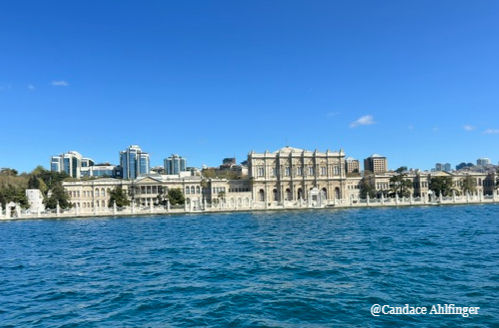
One last important part of our visit to Istanbul was a not-to-be-missed Bosphorous cruise. It was impressive to see sites from both the Asian and European sides of the river, to see the elegant facades of the buildings that were built to impress visitors arriving by boat. Dancing dolphins and schools of jellyfish accompanied our relaxing trip as we viewed the city from another perspective.

We loved our stay in Istanbul, taking time to have Turkish coffee and baklava, sitting on rooftop bars and enjoying the views, eating excellent food, walking through neighborhoods, trying to determine what the numerous fisherman on Galatan bridge were catching, and wandering through parks. There is so much to see and do!

I almost forgot to mention…If you want to see what a real Turkish bath (hammam) is like please follow my experience by clicking here.
I'd love for you to follow our adventures! Just click here and leave your email address.


Comments