


Off the Beaten Path in "Little Paris"
Updated: Aug 16, 2025
We arrived in Bordeaux at the boutique Hotel Cardinal and, after settling in, left to walk around. Disappointingly, the Mirror d’eau (water mirror) was not on, so my best laid plans for awesome pics were gone; however, we decided to use the free time to join the happy hour crowds at one of the local bars before dinner at Tour du Cru, a dinner of oysters and other assorted seafood. (Even with Google translate and an English-speaking waiter we weren’t certain what we ordered, but it was good.) We enjoyed more Bordeaux wine in outdoor seating for a perfect night. Our stroll back to our hotel took us along the Garonne River and by Quincones Place with its towering pillars.

The next morning gave us time to explore the wonderful city of Bordeaux, often referred to as “Little Paris” because of its architecture. We started the morning with pastries—a croissant and pain au chocolat at a local Boulangerie—excellent, of course!

We took the tram to the Cité du Vin stop and then walked to the Bassins des Lumières.
A quick note here: The tram has ticket machines in multiple languages including English. Ask at your hotel or use Rome2rio to determine which stop you need to take. You can choose 1 ride, 2 rides, or an all-day pass. Grab your ticket, scan it when you get on the tram, and you are ready to go. The stops are given on a digital screen. It’s very easy.
One other very important safety tip: Watch out for bicycles! They are definitely not as bad as Amsterdam, but, especially along the scenic boardwalk, there are many “psychopaths in the cycle paths.” (Quoting a tour guide!)

Les Bassins des Lumières was on our “must-do” list for Bordeaux. It is an immersive art exhibit in partnership with Culture Spaces. We had been to the Atelier des Lumières several times in Paris and were enamored with the magnificent displays of art and music. Les Bassins des Lumières captured our attention because of its unique setting—a deserted submarine base. The bunker, capable of hosting 43 U-Boats, was built by the Germans in 1943 and was left largely intact when the Nazis were defeated. Bordeaux has repurposed four of these basins for Culture Spaces, now the largest digital art center in the world. Exhibits change on a routine basis, but we were able to see Egypt of the Pharaohs and The Orientalists—both shows even more impressive because of the reflections that wavered on the still-present water in the basins.

After Les Bassins des Lumières, we walked to the Cité du Vin. The aluminum decanter-shaped building leaves no doubt in visitors’ minds as to the star of the museum. We wandered through the exhibits learning more than I ever knew I didn’t know about French wines and wines throughout the world. The experience is capped at the bar at the top of the building. Included in the entrance fee is a glass of wine that the knowledgeable bartenders will help you pick based on the type of wines you like. (It’s also a chance to try something different.) The view while sipping a Bordeaux wine is a fun experience. (We had purchased tickets in advance for both Les Bassins des Lumières and Cité du Vin. It’s probably not necessary in the off-season, but a big plus during the busier seasons.) If you are hungry, a bustling food market lies next to the Cité du Vin and there are several dining options within the museum.

We finished our evening with a wonderful dinner at Mina Restaurant which was highly recommended by our hotel staff. The food, atmosphere, and service were excellent.
Our second full day in Bordeaux gave us more time to explore some of what this vibrant and growing city has to offer. Bordeaux’s history includes the Celts, Romans, Visigoths, and Franks, before the city began to grow and take its place on the larger European stage beginning with Eleanor, Duchess of Aquitaine (the area including Bordeaux). She married Louis VII in the Cathedral of St. Andre in 1137. Louis’ father, King Louis VI died shortly thereafter, and Louis became King Louis VII.

Fortunately for the people of Aquitaine, Eleanor and Louis did not get along—maybe partially because Louis wanted to be a monk originally and Eleanor--who loved to party and be challenged mentally--failed to give him an heir. Their marriage was annulled which left Eleanor free to marry King Henry II of England. Under English rule Bordeaux and its blossoming wine industry flourished. In fact, Bordeaux was not happy that they were returned to French rule when the 300-year English reign ended in the 1450s during the Hundred Years’ War. They suffered financially when much of the lucrative wine trade with England was lost. A note here: Streets often have two names, one of which is in French, and one is still in Aquitaine.

Bordeaux’s historic district is a UNESCO World Heritage Site because of its architecture, much of which dates to the 18th century. We started our morning at St. Andre Cathedral, aka the Bordeaux Cathedral, with its neighboring bell tower. The bell tower was not built on top of the cathedral for two reasons: the cathedral’s marshy base would not support the additional weight and there was fear that the vibrations from the giant bells would damage the building. The nearby Hotel de Ville, officially Palais Rohan, is the town’s City Hall. (Originally, the Hotels de Ville were homes of aristocracy that served as places for visitors to stay and evolved into administrative centers for the towns so city halls in France are known as Hotel de Ville.)

Venturing further afield, we walked the winding streets to arrive at the Place de la Bourse which includes the magnificent Miroir d’eau, mentioned earlier. Later during our trip, the 37,000 square-foot water mirror was filled so we were able to see the reflection of the Palais de la Bourse and the Hotel des Fermes on its surface.

We loved wandering through the old town, by the Port Cailhau, built in 1494, which was one of the city gates.

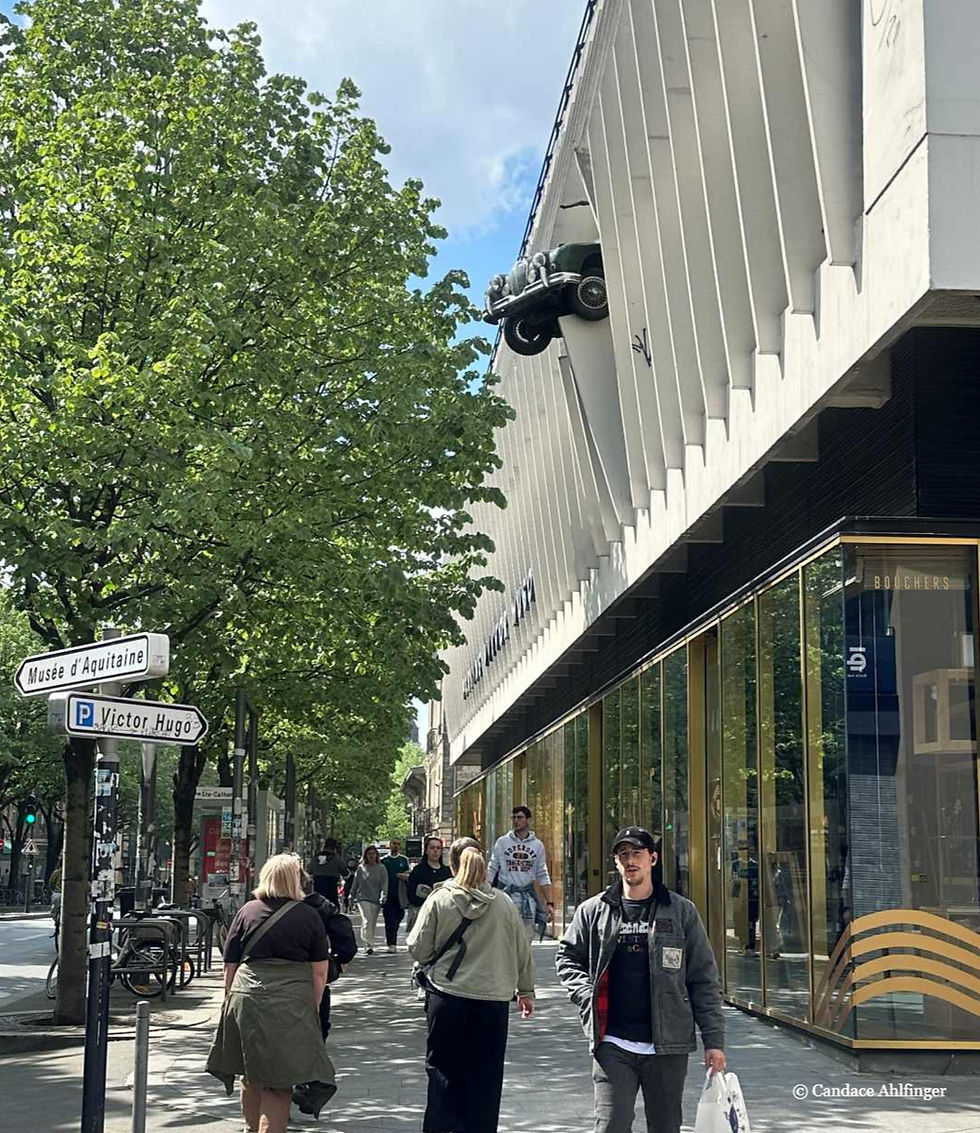
The Porte Dijeaux, built in the 1700s, is one of six remaining gates into the city. We also found the Grosse Cloche, a 15th century bell tower that holds a carefully crafted clock. (The building was once used as a jail for recalcitrant young people.) Another find was high above our heads on Rue Victor Hugo where we discovered a Jaguar hanging precariously out of a multi-story parking garage. Thankfully, the situation was not the result of an accident, but instead is the art of Jean-François Dosso, the Falling Car of Bordeaux.
Because we had several days in Bordeaux, our wandering was interspersed with stops at sidewalk cafes for coffee, wine, and meals, depending on the time of day. We discovered the Grand Theatre located in the Place de la Comédie. Unfortunately, the theater was closed, so we were unable to view its opulent interior.

During our multitudinous trials of coffee shops, wine bars, and restaurants, we did discover that the cuisine of southwest France is very different from that of Paris, but equally delicious. Of course, we had to try the canelé, a small pastry that is a traditional food in Bordeaux.

We actually sampled them on Rue Sainte-Catherine, the longest shopping street in Europe. (Miraculously, canelé was the only thing we bought there!) The number of stores carrying surfing equipment was amazing to us although the Atlantic Ocean isn’t far from Bordeaux. We did learn that surfing opportunities also happen directly in Bordeaux as it is one of only 60 places in the world that experience a tidal bore, a wave caused by a high tide entering a shallow river or estuary—in this case the Girone, the largest estuary in Europe. We didn’t get to see a massive one come in, but ships, and surfers, are always aware of the possibility.

Another day, before boarding a Viking river cruise, we ventured to the Chartrons area which was begun by monks at the Chartreux Abbey. The neighborhood, anchored by the Saint-Louis des Chartrons, has become increasingly popular for younger residents of Bordeaux. Interestingly, new homeowners are given plants of wisteria, jasmine, or honeysuckle to plant by their front doors to add beauty and aroma to the neighborhoods.

Fortunately, our river cruise still gave us more opportunities to explore Bordeaux and its surrounding areas.

Bordeaux—a city of beauty, history, shopping, food, and more—is a city that may be overlooked by tourists, but it is definitely worth a visit. Bordeaux is a fascinating city with architecture that reminds me of Paris, but without the crowds that accompany it.
Info on fantastic day trips from Bordeaux is here!
To learn more about our next stop, this one in San Sebastian, Spain, click here.
Please sign up for my blog by clicking here and putting in your email address.

Comments